Flagship product · X Acceleration Engine

Run your complete streaming operation with Engine.

Engine is the full self-hosted platform for media, subscribers, and multi-server delivery. Codec is a separate product for focused hardware transcoding.

  • Complete platformMedia, users, delivery, and operations
  • From €60/monthLicensed per Engine server
  • Seven-day trialEvaluate the complete workflow
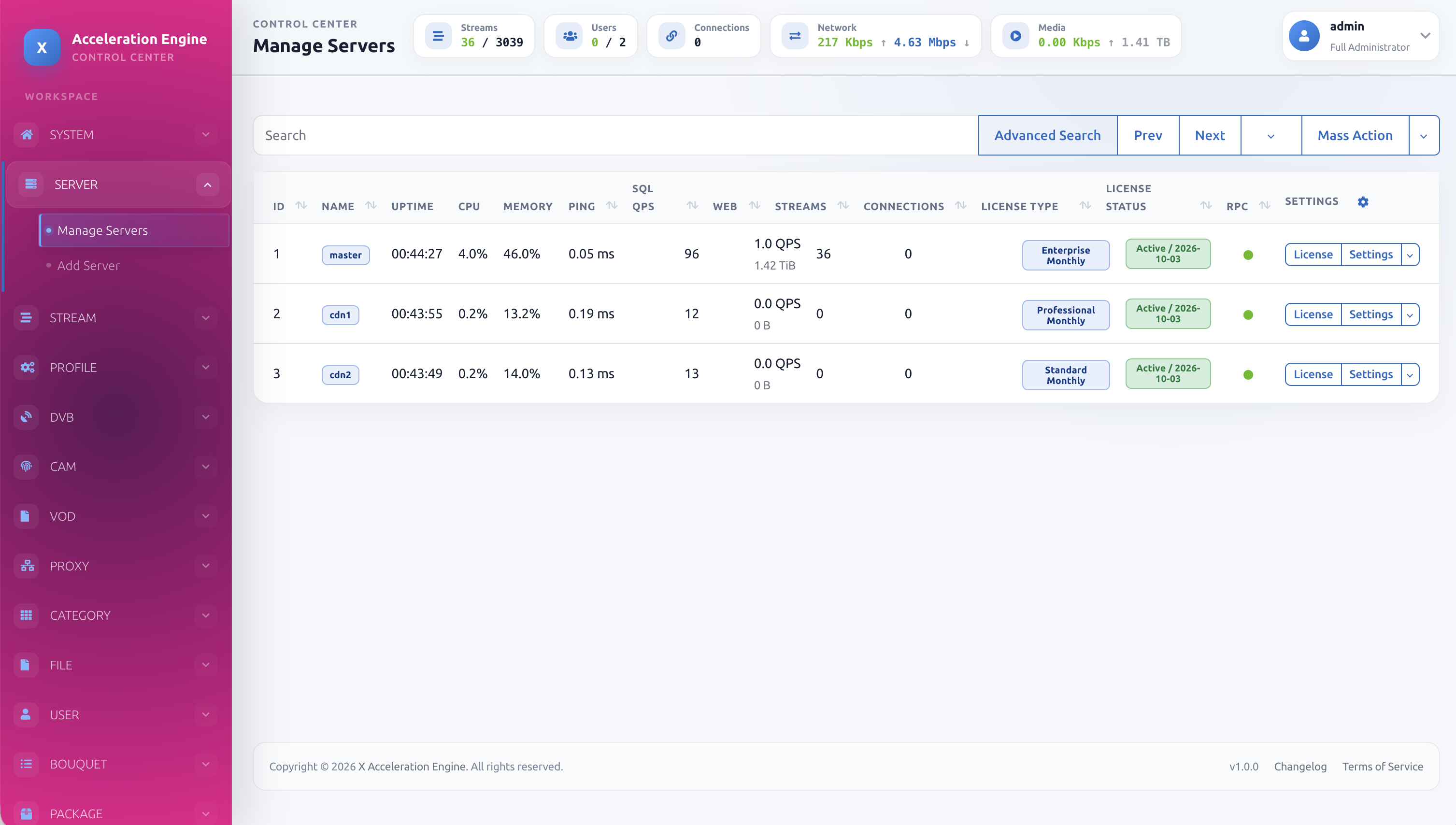
X Acceleration Engine Manage Servers page
Two separate products

Different jobs. Separate licenses. Different pricing.

Engine and Codec are independently licensed products, not editions of the same product. Choose the complete Engine platform or the focused Codec transcoder.

Separate product

X Acceleration Codec

Focused hardware transcoder

Keep the established Codec workflow when you primarily need QuickSync or NVENC transcoding and remuxing.

Codec plans start at30/ month / Codec server
  • QuickSync editions from €30 per month
  • NVENC editions from €60 per month
  • Separate license, trial, and product lifecycle

Choose Codec for existing Codec deployments or a dedicated transcoding layer.

Flagship platform

Run the complete media workflow with Engine

Engine connects media processing, subscriber access, delivery, and day-to-day operations without stitching together separate control panels.

Live, VOD & DVB

Manage live sources, Movies, Series, Episodes, DVB adapters, and SoftCAM workflows.

Transcode & remux

Use CPU, Intel QSV, NVIDIA NVENC, and multi-GPU processing from one interface.

Deliver at scale

Coordinate origins, CDN nodes, load balancing, playback access, and traffic limits.

Operate with evidence

Track system health, media traffic, connections, audit events, and capacity tests.

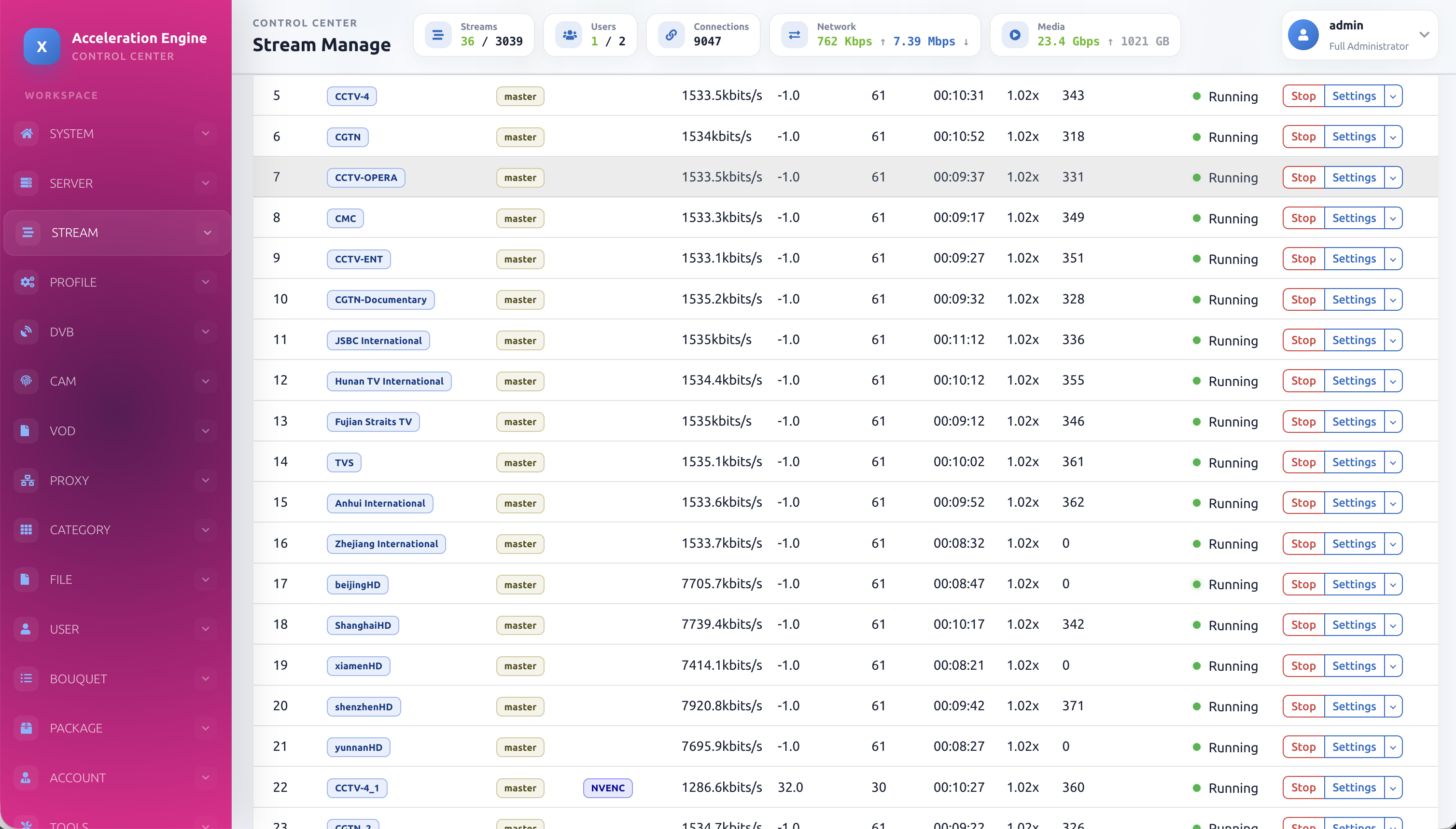
X Acceleration Engine Stream Manage page
Live operations Manage every service in one viewHealth, throughput, sources, outputs, and actions
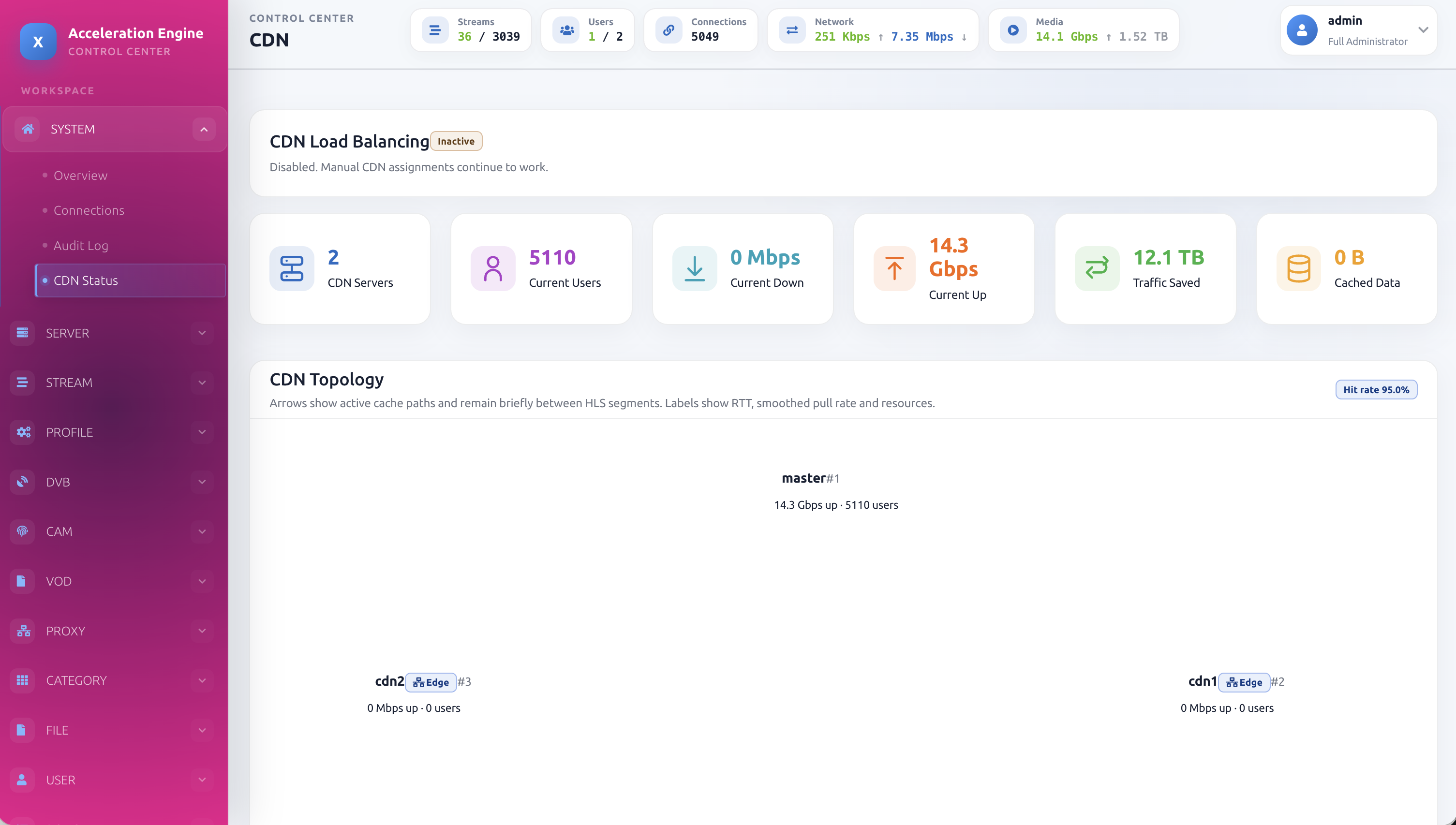
X Acceleration Engine CDN status page
CDN delivery See multi-node delivery as it happensTopology, viewers, bandwidth, cache, and saved traffic
Why Engine is the flagship

Engine delivered the matched workload with roughly 1.8× the CPU efficiency

A same-host fixed-player test compared the complete Engine platform with the separate Codec product. HLS quality was verified independently; HTTP-TS stability remains outside these claims.

~1.8× CPU efficiency

Codec required about 1.8 times Engine's CPU after normalizing by received-player workload and delivered media.

~22× lower baseline RSS

Engine began the matched run with about one twenty-second of Codec's scoped process memory.

~9× lower response P99

Both products completed HLS without request errors or freezes; Engine's response-header P99 was about nine times lower.

Same verified HLS stability

Both products retained their full HLS share with zero observed request errors and zero freezes.

Decision point RecommendedX Acceleration Engine X Acceleration Codec
Primary role Complete media operations and delivery platform Established transcoding-centered platform
Media workflow Live, VOD, DVB, SoftCAM, transcode, remux, and outputs Live transcoding, remuxing, and output workflows
Acceleration CPU, Intel QSV, NVIDIA NVENC, and multi-GPU QuickSync and NVENC product editions
HLS performance Full HLS share retained with zero request errors or freezes; response-header P99 was about 9× lower Full HLS share retained with zero request errors or freezes; startup P99 was about 1.18× lower
Delivery CPU efficiency About 1.8× the efficiency when normalized by received-player workload and CPU-seconds per GiB About 1.8× Engine's CPU cost for the normalized delivery workload
Memory footprint About 22× lower baseline RSS; Codec's sampled load peak was about 1.35× Engine's Higher baseline and sampled-peak RSS across the scoped product processes
HTTP-TS delivery Delivered the full fixed share; response-header P99 was about 17.7× lower in the observed run Delivered the full fixed share at about 1.05× Engine's aggregate HTTP-TS media rate
Delivery & scale Per-server tiers provide 200–2,500 active streams, 1,000–25,000 connections, and 1–25 Gbps delivery bandwidth Scale is primarily determined by CPU/GPU transcoding capacity and the external delivery or CDN layer
Subscriber operations Users, packages, accounts, resellers, sub-resellers, and playback control Established user, package, and reseller workflows
Operational insight Modern telemetry, audit log, maintenance, API, and capacity assessment Familiar Codec monitoring and management tools
Best fit New deployments and teams consolidating their streaming stack Existing Codec environments and focused processing requirements

Benchmark scope: Ratios are derived from a short, same-host internal run with a fixed equal-player workload. CPU efficiency was cross-checked using received-player estimates and CPU-seconds per GiB. Both products completed HLS with zero request errors and freezes. HTTP-TS delivered media on both products, but its playback clock recorded no player-time, so this page makes no HTTP-TS stability claim. Baseline and sampled-peak RSS use each product's scoped processes; post-test RSS is excluded because idle times differed. These are comparative observations, not capacity guarantees. Test your own workload before sizing production. Learn how to run an assessment.

Ready to evaluate Engine?

Test the complete workflow on your own server.

Seven days · One server · No public Store listing